 Skip to content
These tips for selling on Vinted help with the hard part: getting a buyer to press Buy now. Listing a pile of clothes is quick. Turning them into sales takes a few good habits.
I’ve been selling my own clothes, and my kids’ unwanted clothes, on Vinted for years. I’ve made hundreds of pounds doing it, and it doesn’t take a tonne of effort. For me, it’s a simple way to declutter and bring in a little extra income at the same time.
Vinted is an online marketplace for second-hand clothes, shoes and accessories, with categories for kids’ items, home and more. Vinted says it charges sellers no selling fees. The buyer pays the Vinted fee at checkout instead.
So how do you actually get sales? Four things make the biggest difference for me: good photos, a realistic price, a detailed description and friendly communication. If you haven’t listed anything yet, the steps from your first listing to getting paid are in my post on how to sell on Vinted in the UK.
Vinted photo tips: show the item at its best
Buyers judge an item on its photos first. That makes photos the best place to start.
Use natural light. Vinted’s photo advice is to choose daylight over lamplight, and to skip the flash and filters so the colours look true. Take photos from several angles. Make the first photo a full view of the item, and don’t use collages or stock images.
Show any flaws. Take close-ups of details too, like the size label and the tag. If the item is from a well-known or designer brand that people look for, add a photo of the brand name. Vinted asks for close-ups of labels and logos on branded items.
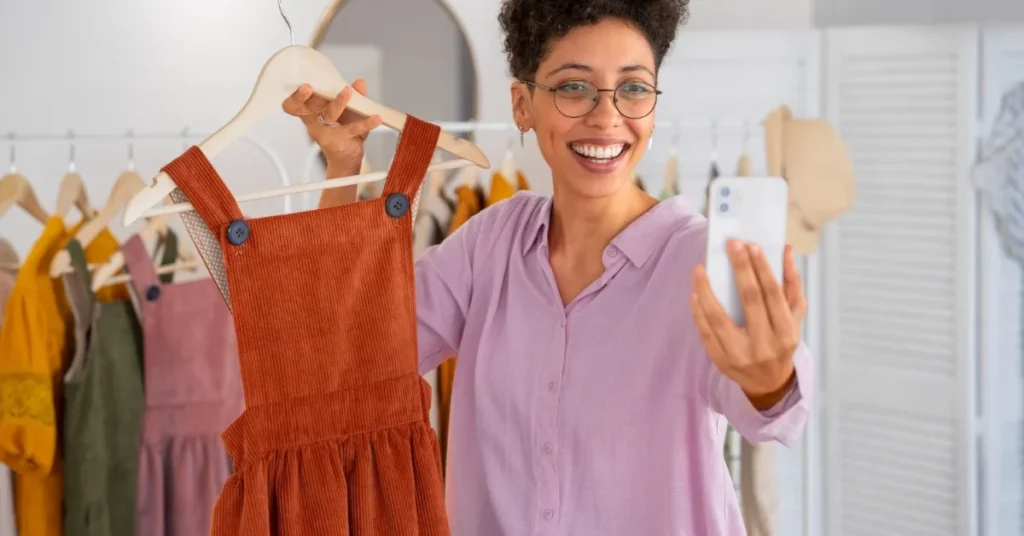
Try a plain background and put the item on a hanger. A busy background pulls attention away from what you’re selling. Vinted says a hanger, a mannequin or a flat lay all work well, and that it’s a good idea to keep your face out of the photos.
You can add up to 20 photos to one listing. A coat or a pair of boots can use as many as it needs.
How to price items on Vinted so they sell
You have to be realistic with pricing. A price that feels fair to you also has to feel fair to a buyer who is comparing your item with several others.
Add up what the buyer really pays
The buyer pays your price, the postage and the Vinted fee. Vinted calls this the Buyer Protection fee and is gradually renaming it the Vinted fee. It usually works out at 3% to 8% of the price plus 30p to 80p. The exact amount depends on the item, the order value and whether it’s a single item or a bundle. On a £10 item, the two ends of that range come to roughly 60p and £1.60, before postage.
You don’t pay that fee, but the buyer sees it in their total. Ask the question they will ask: is it worth it for that total?
Compare similar items before you set a price
Before you set your own price, do a quick search and compare similar items. Check the brand, the size and the condition. You want to be competitive, so a buyer picks your item instead of someone else’s.
Vinted gives suggested prices by condition. For new or like-new items it suggests 60% to 80% of the retail price. For very good condition it suggests 40% to 60%, and for good or satisfactory it suggests 20% to 40%. A dress that cost £40 new and is now in very good condition points to a price of £16 to £24.
Vinted also says a price below the catalogue average might help you sell faster, and that a discount can help with items that don’t suit the current season. If an item sits, you can edit the price on the published listing.
Use bundle discounts and offers
Bundle discounts encourage people to buy more than one item from you. You can turn them on in your settings and choose the discount you want to give. If a buyer likes three of your kids’ tops, a small discount on the set can tip them from one item to three.
Offers let buyers negotiate on price. Decide your lowest price before you start, so you can say yes to a fair offer without second-guessing it.
How to write a Vinted description that sells
Put everything in the description. It saves back and forth in your messages, and a buyer who already has every answer can buy straight away.
Include the sizes or measurements, the condition and any flaws or defects. Add personal details too, like whether the item comes up small or big. Vinted also asks sellers to show flaws in the photos and mention them in the description.
Then add the words people search for: the brand, the colour and the style. That makes the item easy to find. Only use brand names that are true, because Vinted says not to add hashtags of unrelated brands.
A listing might read like this:
Boys’ green waterproof jacket, age 5 to 6, Next. Fits a little big. Fleece lining and a zip-off hood. Small mark on the left cuff, see photo 4. Washed and ready to post.
That tells the buyer the size, the brand, the fit and the flaw. There’s very little left for them to ask.
Communication on Vinted: how to get positive reviews
Good communication is key to being a successful seller on Vinted. Let people know when you will post items. That encourages them to buy from you. Message them again once they have bought.
In my experience, this prompts more positive reviews, and positive reviews lead to more sales. Quick posting helps too. Vinted gives you five business days to send an item after it’s bought, unless the buyer agrees to extend the deadline.
Watch for favourites as well. If another member favourites your item, Vinted sends you a notification. Drop them a message. You can also use the Make an offer button to give them a slightly lower price. A small nudge can turn a like into a sale.
What are your best tips for selling on Vinted?
Those are my top four tips for selling on Vinted: photos, price, description and messages. Try changing one thing on your next batch of listings, such as retaking the photos in daylight.
If you enjoy the photo side of selling, you could also learn how to make money from content creation with zero followers. Or look through some more side hustle ideas.
Are you thinking about starting to sell on Vinted? Maybe you already do? Drop your top tips in the comments below.



Pingback: How to Find the Right Side Hustle for You (No Guesswork) – The Savvy Spender